Jack Vanderbilt
The SwarmJack Vanderbilt is the Central Intelligence Agency chief whose changing explanations of the oceanic crisis carry him from dismissing the possibility of a nonhuman enemy to authorizing surveillance of the Yrr. On the USS Independence, he is both a political interpreter of scientific evidence and an operative of the security apparatus: quick to demand decisive answers, yet ultimately entangled in a covert effort against a researcher who may become a security risk. His final recorded action is to reach for a gun and fire during a confrontation with Leon Anawak and Jack Greywolf.
Position and Introduction
Vanderbilt arrives at a meeting in the Flag Command Center after flying by helicopter from Nanaimo. He is introduced to Samantha Crowe as the head of the Central Intelligence Agency; his conspicuously informal clothes and joking greeting set him apart from the military officers and researchers around him. He asks Crowe what constitutes intelligence, making a scientific question the opening point of contact between an intelligence chief and a specialist in nonhuman minds.
Crowe answers by laying out competing ways to define intelligence: as something valued differently across cultures, as a set of thought processes, as a measurable property, or as the capacity to adapt to a changing environment. She also distinguishes accounts of intelligence as acquired from those that regard it as innate. Vanderbilt’s question therefore establishes a problem that will recur in his dealings with the scientists: what counts as intelligence cannot be settled simply by giving it a name, and the answer affects whether the Yrr can be treated as an enemy, an organism, or a mind.
From Geopolitical Suspicion to an Oceanic Threat
Vanderbilt initially reaches for familiar geopolitical explanations. When the discussion turns to possible threats, he impatiently points toward the Middle East. Later, confronted with an account of a catastrophe that could affect coastal populations and the climate worldwide, he dismisses the idea of the Yrr as nonexistent and insists that their identity must be established. The scale of the danger does not immediately dislodge his preference for explanations that fit existing security categories.
The committee’s wider response places his position within a crisis increasingly framed as war. At Chateau Whistler, Judith Li argues that public disclosure could provoke panic, requires committee members to keep their work secret, and describes the conflict as one humanity must understand before it can win. The setting itself is insulated from the press, and the committee presents its presence as an exercise. This is the political environment in which Vanderbilt operates: incomplete scientific knowledge is treated as a security problem, while secrecy is defended as a means of preserving public calm.
At a later discussion of the attacks, Vanderbilt rejects the idea that the methods are too unfamiliar to warrant a human response. The proposed use of SURTASS LFA against whales translates uncertainty into a military countermeasure: the animals are to be deafened by sonar because, in the committee’s view, someone is controlling them. The contrast between the scientific demand to discover what is causing the attacks and the willingness to strike before the cause is established marks one of his recurring conflicts with the investigators.
Surveillance and the Demand for Proof
Vanderbilt’s skepticism does not remain fixed. After the human-enemy hypothesis comes under pressure, he says he is prepared to be proved wrong and proposes that the Central Intelligence Agency track the Yrr if they are not human agents. The change is significant but limited: he makes room for a different opponent without giving up the assumption that the agency should monitor it and learn what it intends. His earlier request to determine who the attackers are becomes a broader intelligence objective directed at a possible nonhuman mind.
That objective sits alongside surveillance of the people studying the crisis. In one scene, screens show the sleeping or waking occupants of individual cabins while uniformed men watch; Li and Vanderbilt stand in the background. The arrangement gives Li knowledge of the researchers’ whereabouts, activities, and conversations. Vanderbilt is present within this apparatus, though the scene does not establish that he designed or personally controls it. The researchers’ work is thus watched as well as evaluated, and the search for an unknown intelligence unfolds under the gaze of the committee that is meant to respond to it.
Vanderbilt’s impatience becomes especially visible when the scientists examine the jelly-like cells. As Sue Oliviera presents evidence, he struggles to follow the genetics, while Salomon Peak appears bewildered and Li’s command of the subject seems strained. Vanderbilt nevertheless takes a firm position: the cells are not natural and must be a human-made biological weapon. He presses for a formula rather than accepting conditional language about what might or could be true. His insistence gives the scene its sharp contrast between the scientists’ unresolved evidence and the intelligence chief’s appetite for a usable conclusion.
Relations, Assignments, and the Security Apparatus
Vanderbilt’s dealings with Mick Rubin show how his judgments can be both provisional and transactional. After Rubin gives a report, Vanderbilt thanks him and says he is back in the agency’s favor for the time being, while reminding him of his failure during the well-deck incident. When Judith Li raises the possibility that Rubin’s cover has been exposed, Vanderbilt responds with a teasing remark about Li’s harshness. The exchange makes clear that approval is conditional and that operational setbacks remain part of the team’s accounting, even when a colleague has just been useful.
His relationship with Sigur Johanson is more consequential. Vanderbilt has been assigned to deal with Johanson and understands that the instructions require him to remove the researcher as a security risk. The narration distinguishes that assignment from Vanderbilt’s personal response: he has no strong desire to kill Johanson and, in an unusual way, likes him, but neither feeling changes his willingness to carry out the order. The tension is not resolved by a reconciliation; personal regard remains secondary to the task as Vanderbilt understands it.
Confrontation and Narrative Role
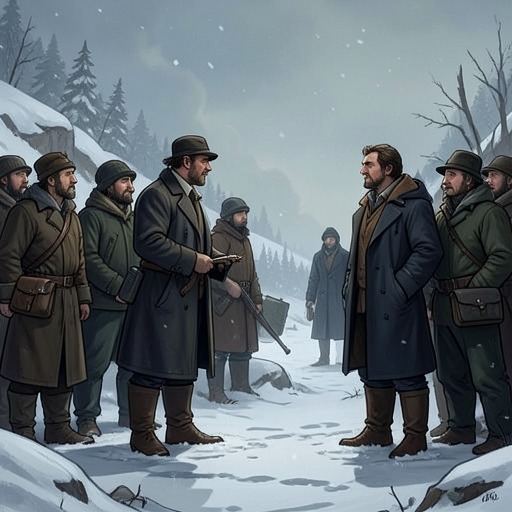
The security role becomes physical when Vanderbilt blocks Leon Anawak’s path, armed, with bodies already on the floor. Leon denounces him as a traitor. Jack Greywolf then lets go of Vanderbilt, who falls backward; his gun lies beside him, and he reaches for it and fires. The sequence ends with the shot, without establishing in the available account what happens to Vanderbilt afterward. It is the starkest reversal in his trajectory: the man who has advocated surveillance and force is no longer directing a response from a secure room but is caught inside the violence his work has helped authorize.
Vanderbilt’s narrative importance lies in the way he turns uncertainty into an intelligence problem. His changing position—from geopolitical suspicion, to dismissal of the Yrr, to a willingness to surveil them—shows a capacity to revise the identity of the presumed enemy, but not to abandon the methods of control. The same habit shapes his response to scientific ambiguity: he presses for a definitive formula, entertains the possibility of a human biological weapon, and supports a security response before the researchers have settled what they are facing. His final armed confrontation brings that logic into the open, as the effort to manage the crisis through secrecy and force converges with the conflict among the people charged with investigating it.